
Autonomous agents are dominating crypto markets’ volume. During token launches, that share climbs above 70 per cent.
By June, more than 120,000 agent-operated wallets were active on Solana alone, each executing an average of 11.4 transactions a day. Human-operated wallets averaged 2.1. In three months, AI-driven wallets went from handling 8 per cent of daily memecoin DEX volume on the network to 34 per cent.
The infrastructure providers have responded accordingly.
Kraken shipped an open-source command-line interface late last year with 134 trading commands designed for AI systems, not human traders. Binance followed in March with modular agent skills covering execution, wallet intelligence and smart-money tracking.
In June, MetaMask launched Agent Wallet, a self-custodial product built for autonomous agents to execute DeFi transactions across nine blockchain networks. Hyperliquid support extends its reach into perpetual futures. ConsenSys, MetaMask’s parent, is targeting an AI agent market it projects at $236bn by 2034.
What is missing from this build-out is the strategy layer.
The exchanges are offering plumbing. The wallet providers are offering keys. But few products have tried to package a specific trading strategy — complete with signal generation, a risk framework and position management — into an agent that a retail user simply deploys and leaves alone.
This is DeFi yields’ next phase. And Deploy changes that forever.
Its new agent, Super Perps, is an autonomous directional trader for perpetual futures on BTC, ETH, SOL and HYPE. It does not require the user to configure signals, approve trades or monitor positions. Every four hours, day and night, the agent takes a fresh read of the market, decides whether to go long, short or stay flat, sizes the position against a fixed risk budget, and manages the trade through to exit.
How the decision loop works
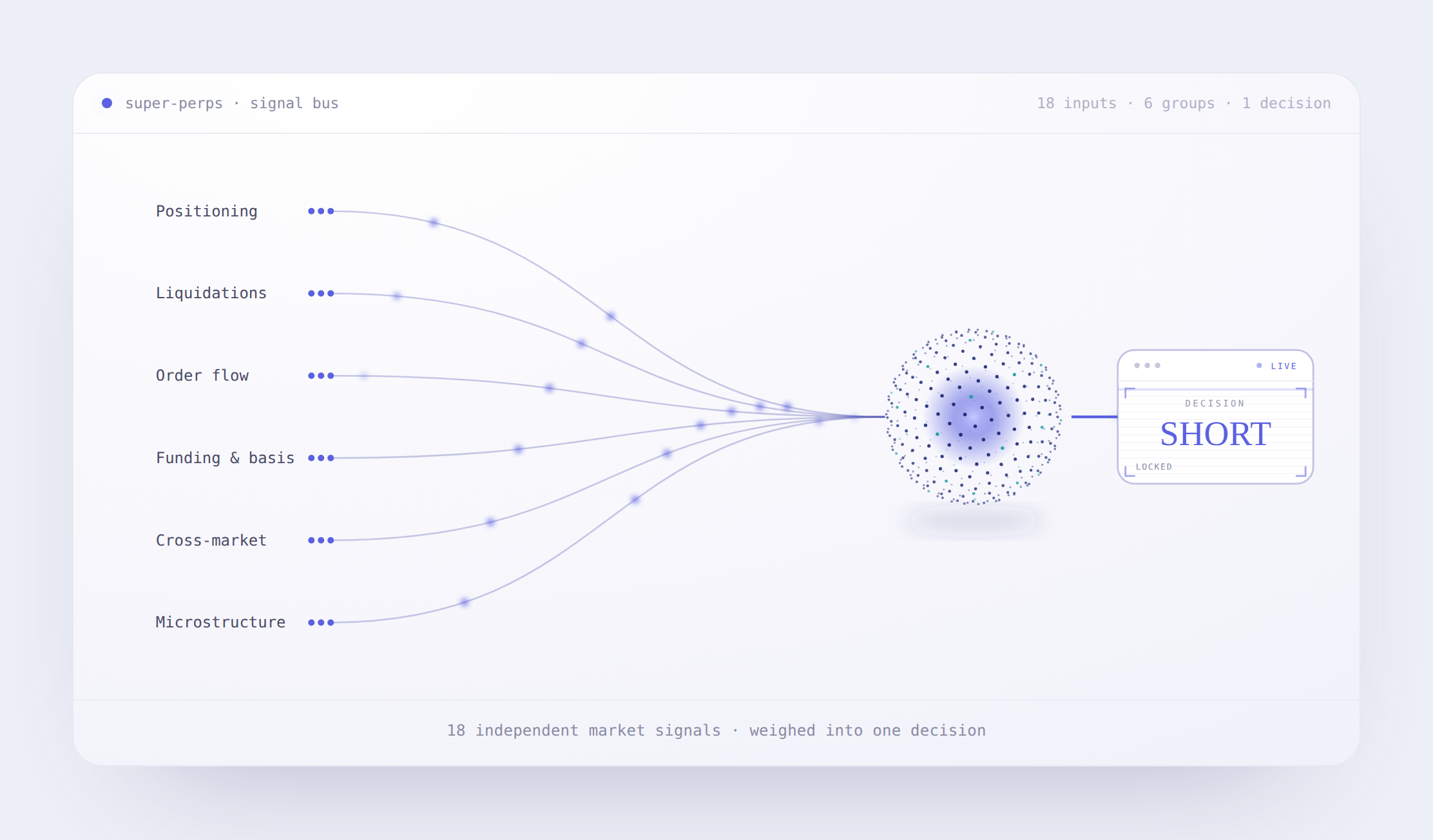
Every four hours the agent starts from scratch. It carries no view from prior cycles. It builds the strongest case for price rising and the strongest case for price falling, then weighs one against the other.
A trade fires only when the evidence tilts far enough in one direction.
In a backtest covering June 2025 to July 2026, the agent completed 2,298 market reviews and chose not to trade on 1,350 of them. More often than not, it waited.
The signal set draws on eighteen market inputs across six categories:
- Positioning data (funding rates, open interest)
- Liquidation zones where crowded positions may be forced to close
- Order-book depth and buy–sell flow
- Divergences between large traders and retail
- Cross-market confirmation across exchanges
- Timeframes and options conditions
And a requirement that no single input decides a trade: the agent acts only when several independent readings agree.
The risk framework
The risk framework is what separates this from most retail trading bots.
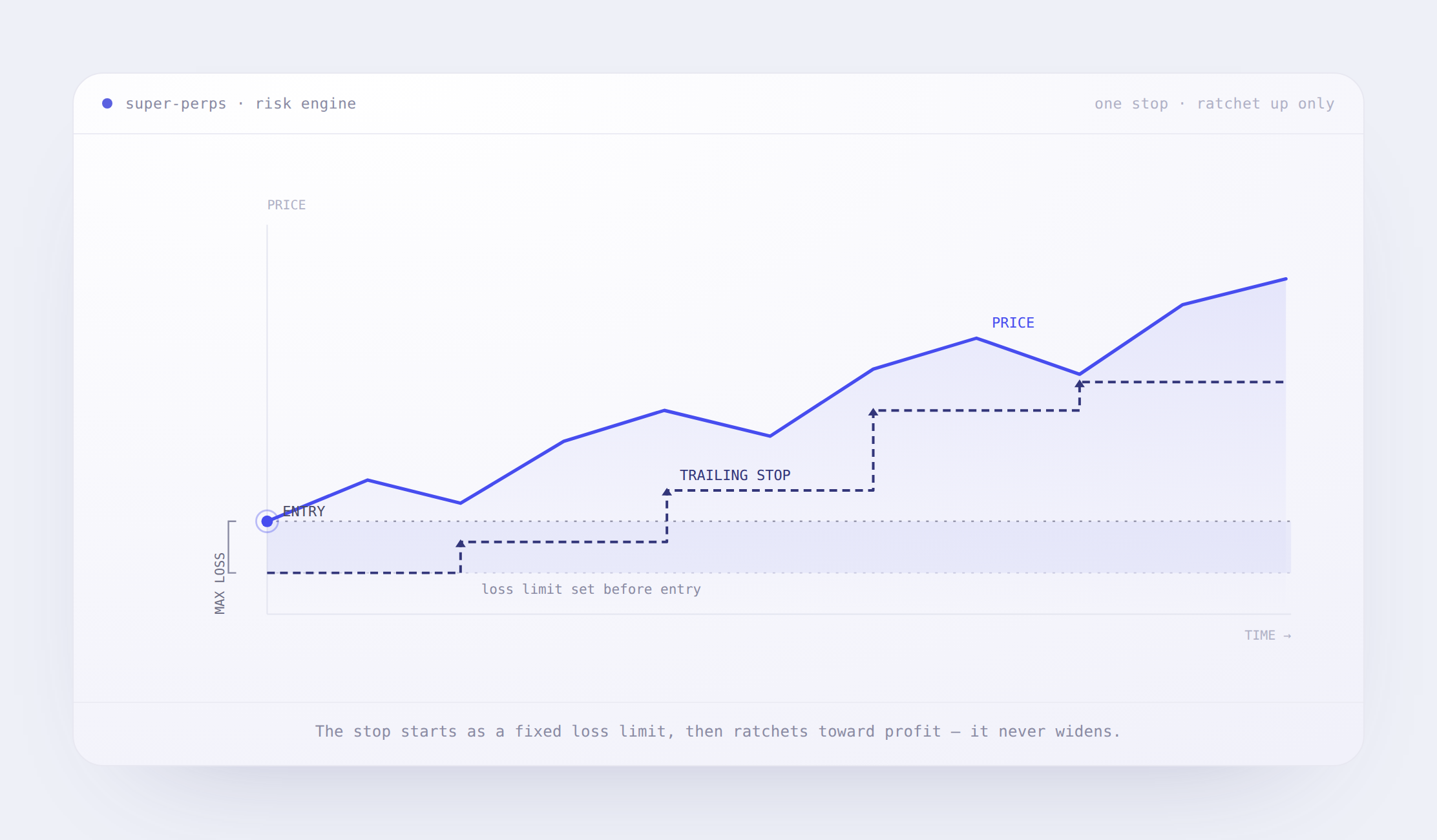
Every position opens with a defined loss limit, set before entry. The agent sizes the position from that limit, not from the strength of the signal. A strong reading does not produce a larger bet.
The stop is never widened after entry. It only moves in the direction that protects capital. As a trade moves into profit, a trailing stop ratchets behind the price.
Deploy describes three rules as non-negotiable: the loss limit is set before entry, sizing follows from it, and the stop only tightens.
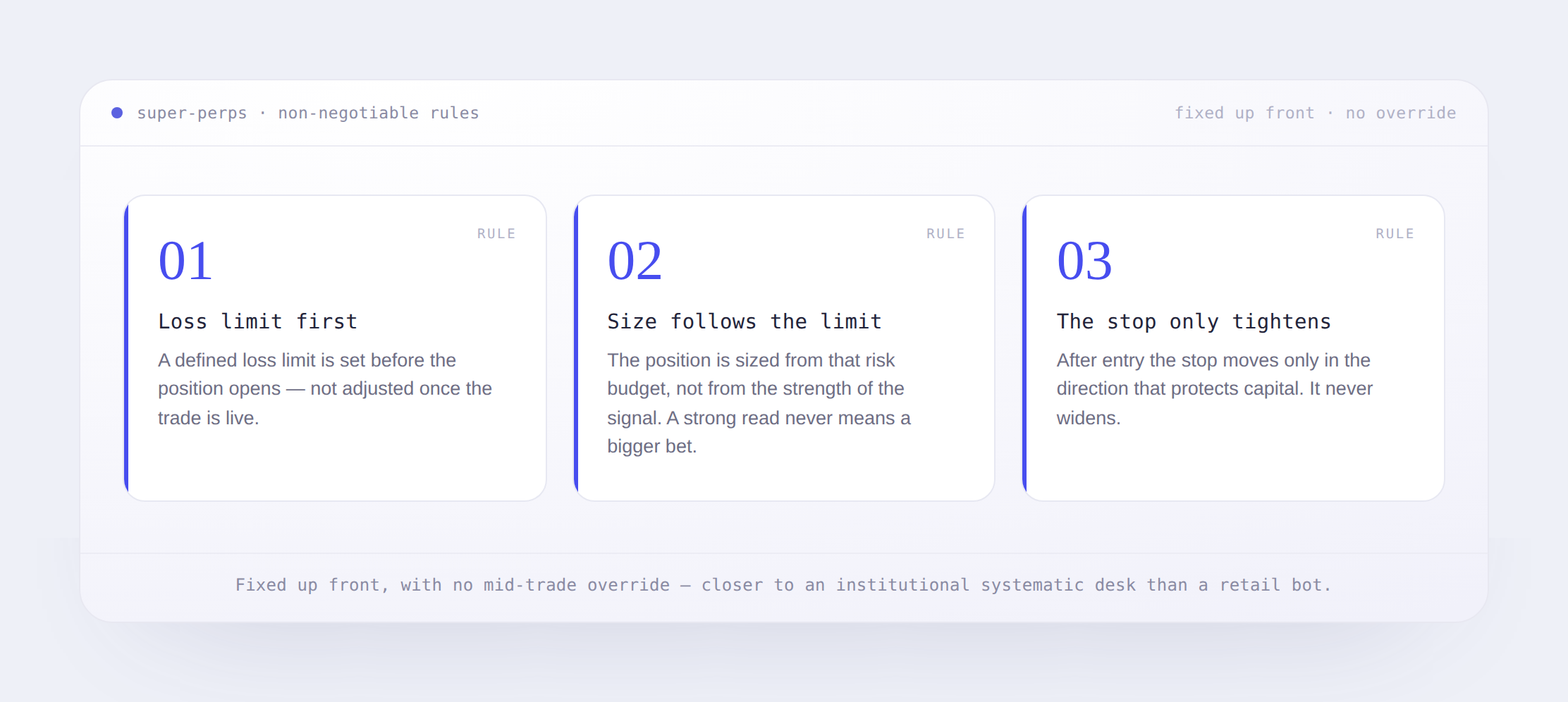
Most retail bots let users set risk parameters they may not fully understand, or allow risk controls to be adjusted mid-trade. Deploy’s approach — fixing the risk budget up front and giving the agent no override — is closer to how institutional systematic funds operate.
The numbers
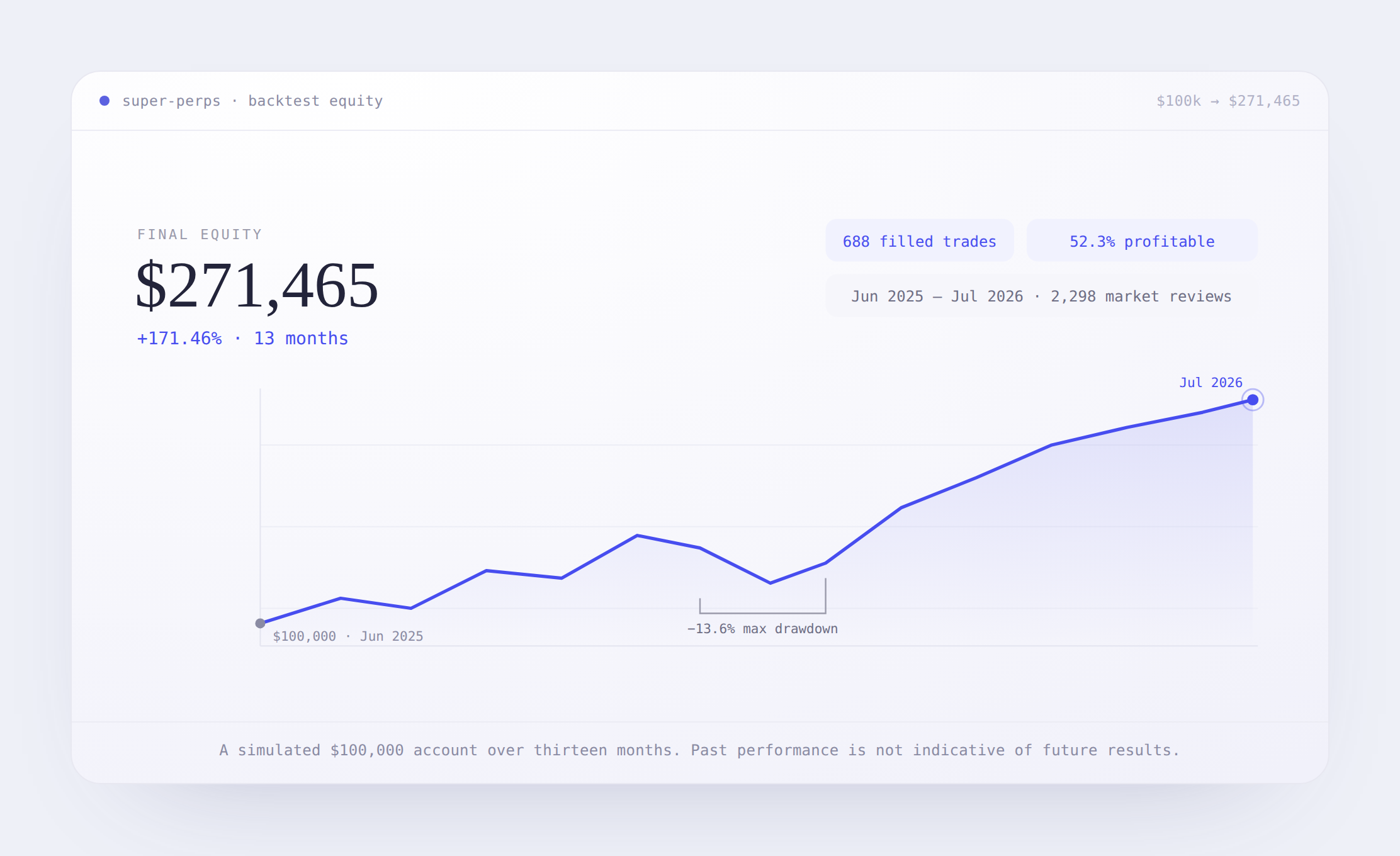
Over thirteen months, a simulated $100,000 account grew to $271,465 — a return of 171.46 per cent across 688 filled trades. Of the resolved trades, 52.3 per cent were profitable. Maximum drawdown was 13.6 per cent.
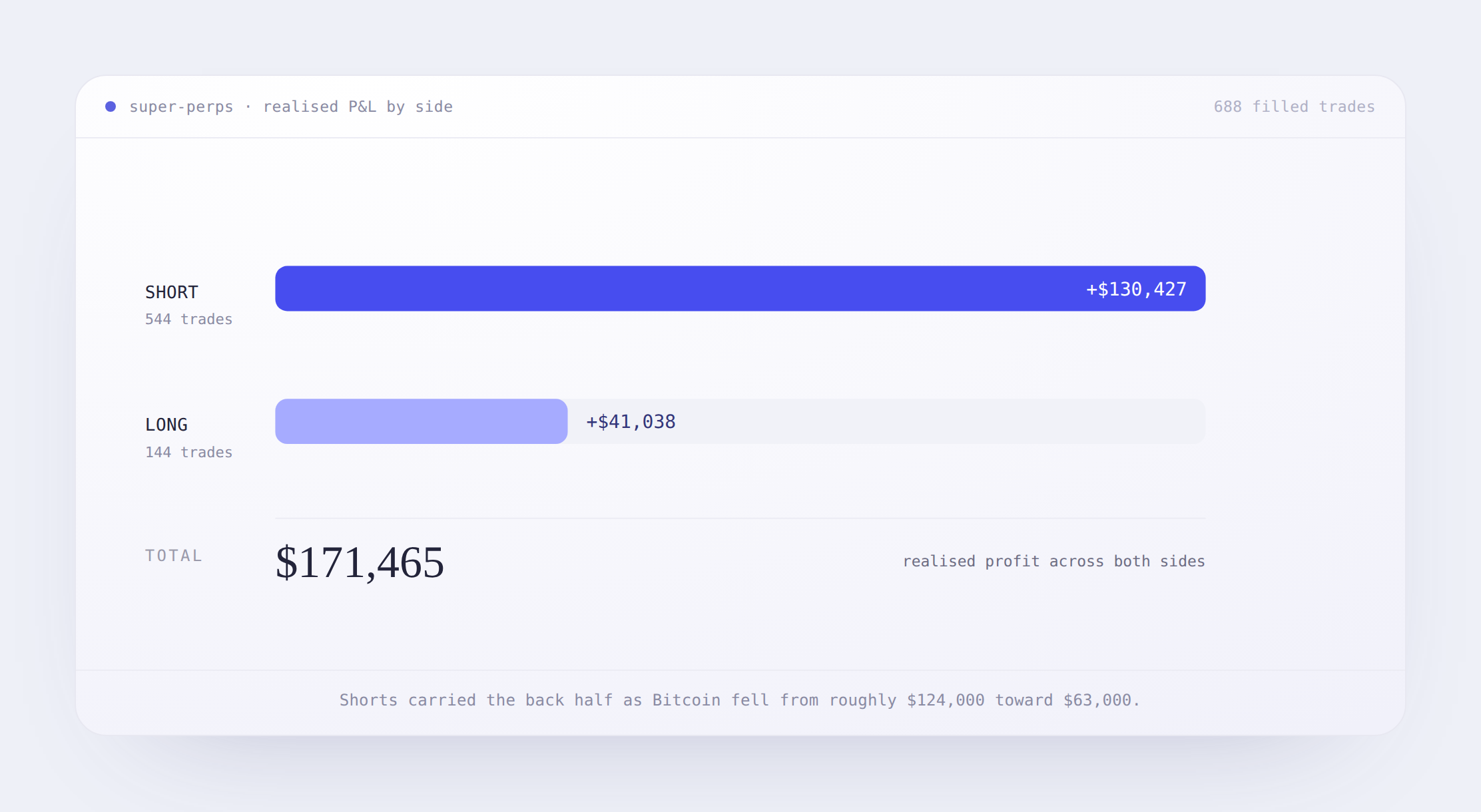
The agent traded both directions: 544 short trades generated $130,427 in profit, while 144 longs added $41,038. Shorts carried most of the result during the back half of the test window, when Bitcoin fell from roughly $124,000 to near $63,000.
The edge sits in the asymmetry between how winners and losers are managed. Losers get cut at a fixed stop, while winners run with a trailing exit. That structure can produce strong returns on a modest win rate, as long as the average winner is meaningfully larger than the average loser.
The venue
Super Perps trades on Hyperliquid, and the choice of venue matters.
Hyperliquid processed $633bn in trading volume during the first quarter of 2026 alone and now commands roughly 70 per cent of all on-chain perpetual futures volume.
Its share of global perpetual open interest — measured against centralised venues, not just decentralised ones — reached a record 9.3 per cent by mid-year. Open positions on the platform hit $11bn, the highest level in 2026. Hyperliquid has generated over $1bn in cumulative revenue and supports more than 300 markets.
For an autonomous agent trading crypto perps, Hyperliquid offers the deepest on-chain liquidity available, non-custodial settlement in USDC and sub-second finality.
The regulatory moment
The regulatory backdrop is evolving alongside this.
A joint SEC–CFTC interpretive release in March 2026 classified major crypto assets into five categories, explicitly designating BTC, ETH and SOL as digital commodities. Three of Super Perps’ four traded assets now have clearer regulatory footing.
The CFTC has also launched an Innovation Task Force whose mandate covers AI and autonomous systems. No AI-specific registration rule exists as of mid-2026. The governing principle is that function, not technology, triggers regulation: what the agent does with money matters, not the fact that it runs autonomously.
What next
Automated agents are becoming a larger share of crypto derivatives volume every quarter. The biggest names in the industry are building the infrastructure to support them. Products like Super Perps are packaging autonomous execution for users who would otherwise be trading manually — and probably trading worse.
For now, the retail trader faces a practical choice: compete against autonomous systems that do not sleep, do not tilt, and size every position from a risk budget rather than a feeling — or hand the job to one of those systems.
Neither option is comfortable. But pretending the market still belongs to people watching charts may be the least comfortable option of all.
The agent remains open for deposits of $10,000 or more starting today with a slow release.
To stay close, join Deploy’s Telegram for upcoming updates.
— Deploy Team